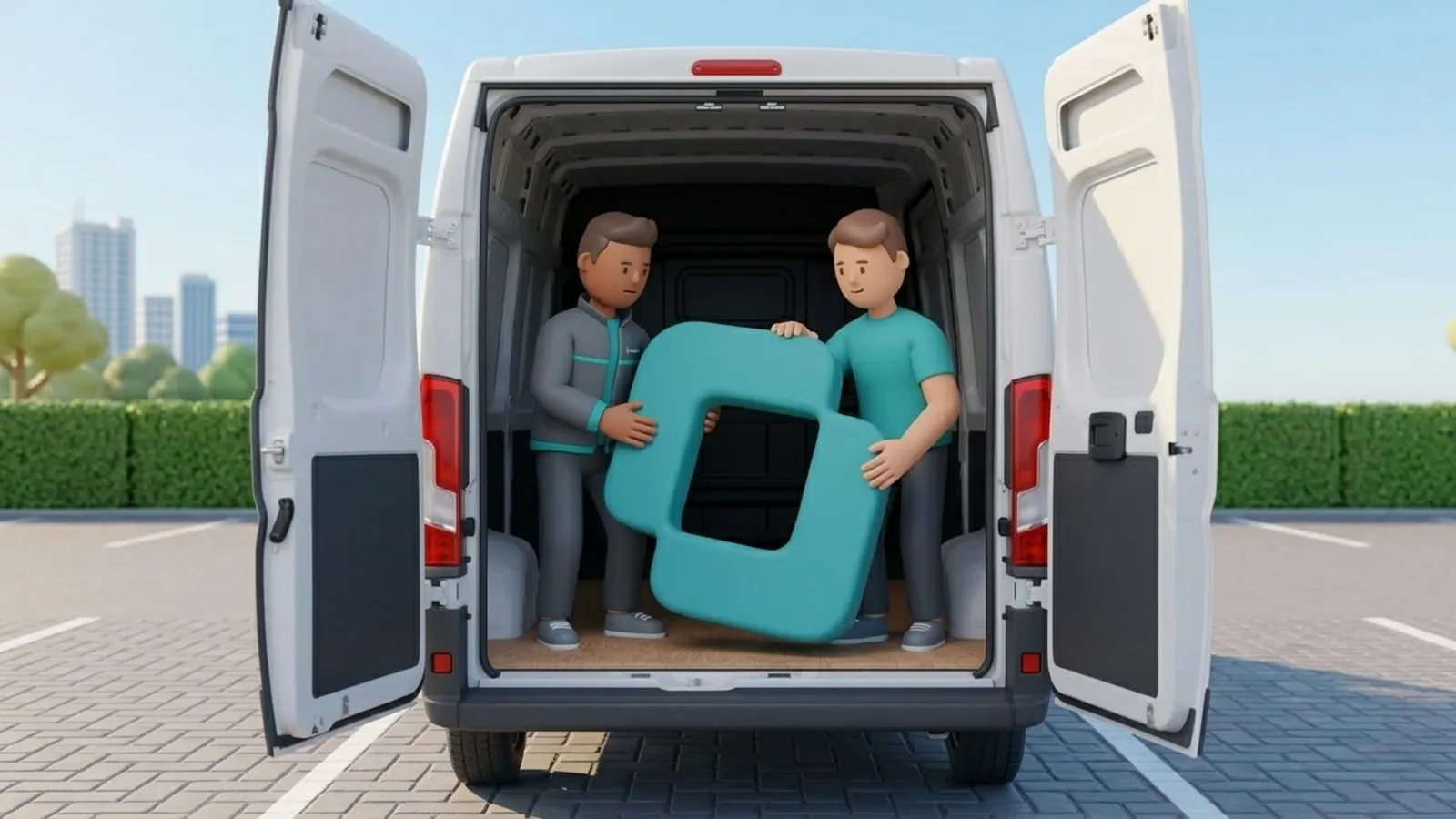
How many people you need for a move, by flat size
Too few people means a long day, too many means chaos. How many people you need for a move can be estimated quite accurately. It depends on the volume of your belongings, the floor and whether the building has a working lift.
Studio and 1+kk flat
Two people are enough. One carries, the other holds the doors and arranges the load in the van. With smaller furniture and twenty boxes, you're done in half a day. A third person helps mainly with the washing machine and fridge.
2+kk and 3+1 flats
Three to four people are ideal. Two carry the heavy items, one forms a chain with the boxes and one stacks the load in the van. With four people, work doesn't stop even when someone goes off to unlock the new flat.
A larger flat or a house
Above five people, more no longer means faster. People pass each other on the stairs and get in each other's way in the flat. Six people split into two teams, where one packs and the other loads, is better than six people all doing the same thing.
What increases the number of people
Floor and lift
Every floor without a lift adds one person. Carrying things up and down stairs is the most demanding part of the day and people tire quickly. If there is a lift, check its dimensions and load capacity in advance so you don't end up standing in front of it wondering how the wardrobe will fit.
Heavy and oversized items
A washing machine, fridge, solid wardrobe and piano need an extra pair of hands. Lifting them down the stairs with just two people is risky for both your back and the appliances. For really heavy items, it pays to call in a specialist firm just for those.
Distance to the van
Fifty metres to the entrance changes the whole logistics. If you can't stop in front of the building, you need an extra person to carry things between the entrance and the van. A sack truck or folding trolley helps.
Two addresses at once
Ideally, have someone at both ends. One unlocks the new flat, measures the space and takes in the things, while the others load. Without that, the whole crew stands in front of a locked door waiting for whoever has the keys.
Children and pets
Small children and the dog don't count as helpers. On the contrary, they keep one person fully occupied. If you have somewhere to take them for the day, you'll save yourself more work than if another neighbour came to help.
How to divide the work
Appoint one person in charge
Someone has to say what gets loaded next. Ideally the person who knows the flat and knows where everything is. Without that, three people bring three wardrobes at once while the van is still missing its base layer of boxes.
One person stays with the van
Loading is the skilled part of the job. Whoever stacks the load doesn't leave the van. They're the only one who can see how much space is left, and they build the load up gradually, not just at the end. The others bring things to the doors for them.
Don't mix packing and carrying
On moving day, nobody packs any more. If you leave packing for the morning, your helpers stand around waiting. Boxes should be closed and labelled in advance so that on D-day they just get carried.
Agree on signals
When carrying furniture, it must be clear who's giving directions. The person walking backwards, who can't see behind them, always leads, but the other one guides them. Short commands such as stop, right, lower work better than long sentences.
Practical rules for the whole day
Safe lifting
Lift with your legs, not your back. Keep the load as close to your body as possible and don't twist at the waist while holding it. Most injuries happen in the last hour, when everyone is tired and stops paying attention. Gloves and sturdy footwear go without saying.
Food, drink and breaks
Sort out drinks right at the start. A litre of water per person is the minimum, more in summer. A short break after each van load keeps the pace better than one long break in the middle of the day.
Tell people when you'll finish
A clearly set end keeps up the pace. If you know from the start that you'll be done at five o'clock, the work gets planned accordingly. An open end leads to long breaks and to the last box being loaded in the dark.
Who drives the van
Only the person named in the contract may drive. A second driver can be added, but this has to be reported in advance. Don't count on just anyone in the crew getting behind the wheel. All you need is a category B driving licence and two proofs of identity.
When to hire professionals
Your own crew makes sense up to a point. For a piano, a safe or a fifth-floor flat with no lift, a specialist firm is cheaper than damaged furniture. We don't offer vans with a driver — you drive the van yourself. The PROFI programme is intended for companies and tradespeople, and you'll find the vans in our fleet.